Draw. Pull. Make it yours.
Sketch lines, rectangles, circles, and freehand outlines. Turn faces into forms with Push/Pull, then move, scale, offset, and paint.
 BenchUp.
BenchUp is a free, open-source 3D modeling app for woodworking and furniture design. Plan a shelf, table, cabinet, or workbench with exact measurements, wood joinery, and grain orientation before you build. Use it on Windows, macOS, Linux, or right in your desktop browser.

Free & open source. No account needed.
Made for a desktop browser and a mouse.
Start with a simple shape. Keep the tools you need close, and your model at the center.
Sketch lines, rectangles, circles, and freehand outlines. Turn faces into forms with Push/Pull, then move, scale, offset, and paint.
Snap to geometry and axes, type exact lengths, and add dimensions. Organize the bigger picture with groups, components, and tags.
Autosave locally and download portable .bup projects. Import SketchUp geometry or export an OBJ to take your model further.
See the wood, fit the boards, and shape the edges before the first cut.
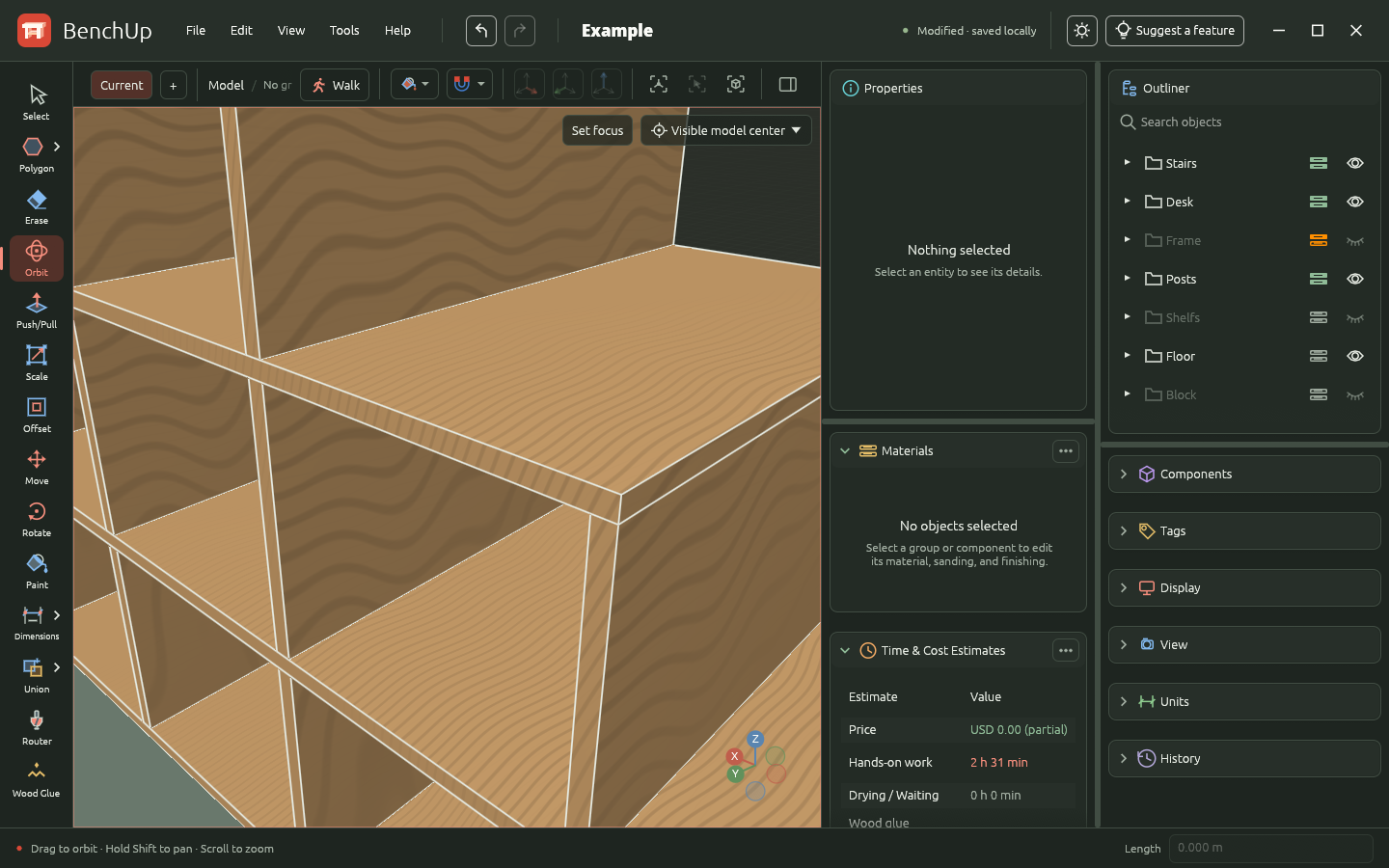
See procedural grain across your boards in the Materials face style. Assign wood stock, set the grain direction, and preview the appearance of sanding and finishing steps in the full assembly.
Adjust wood colors and product appearance in the material catalog, then fine-tune the recipe for each part. Grain orientation stays with the project and follows the boards when they rotate.
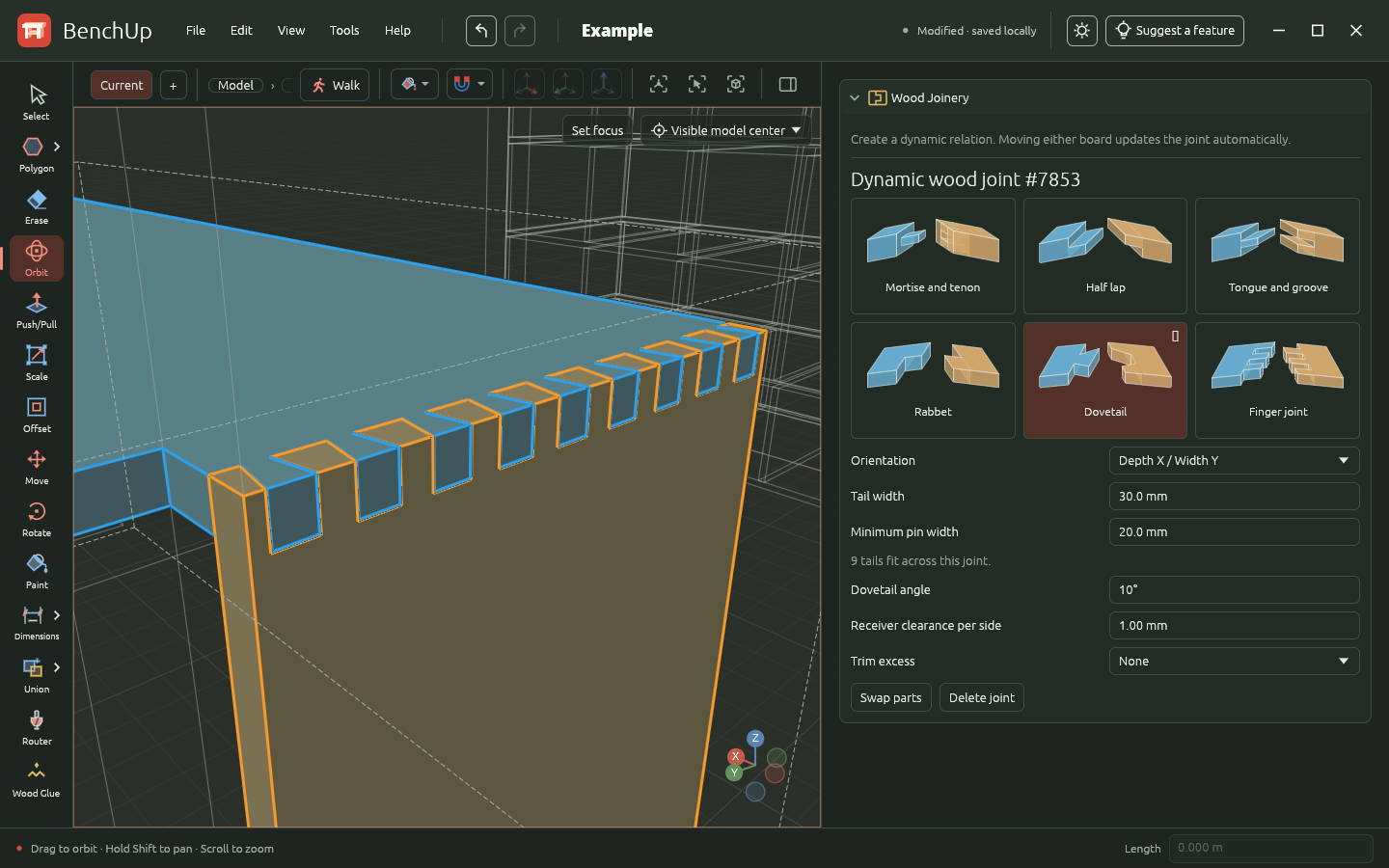
Create mortise-and-tenon, half-lap, tongue-and-groove, rabbet, dovetail, and finger joints, including angled connections. Adjust dimensions and clearance with live previews. Dynamic joints update automatically when either board moves.
Inspect machining diagnostics and cut guides, and trim excess material while keeping the original boards editable.
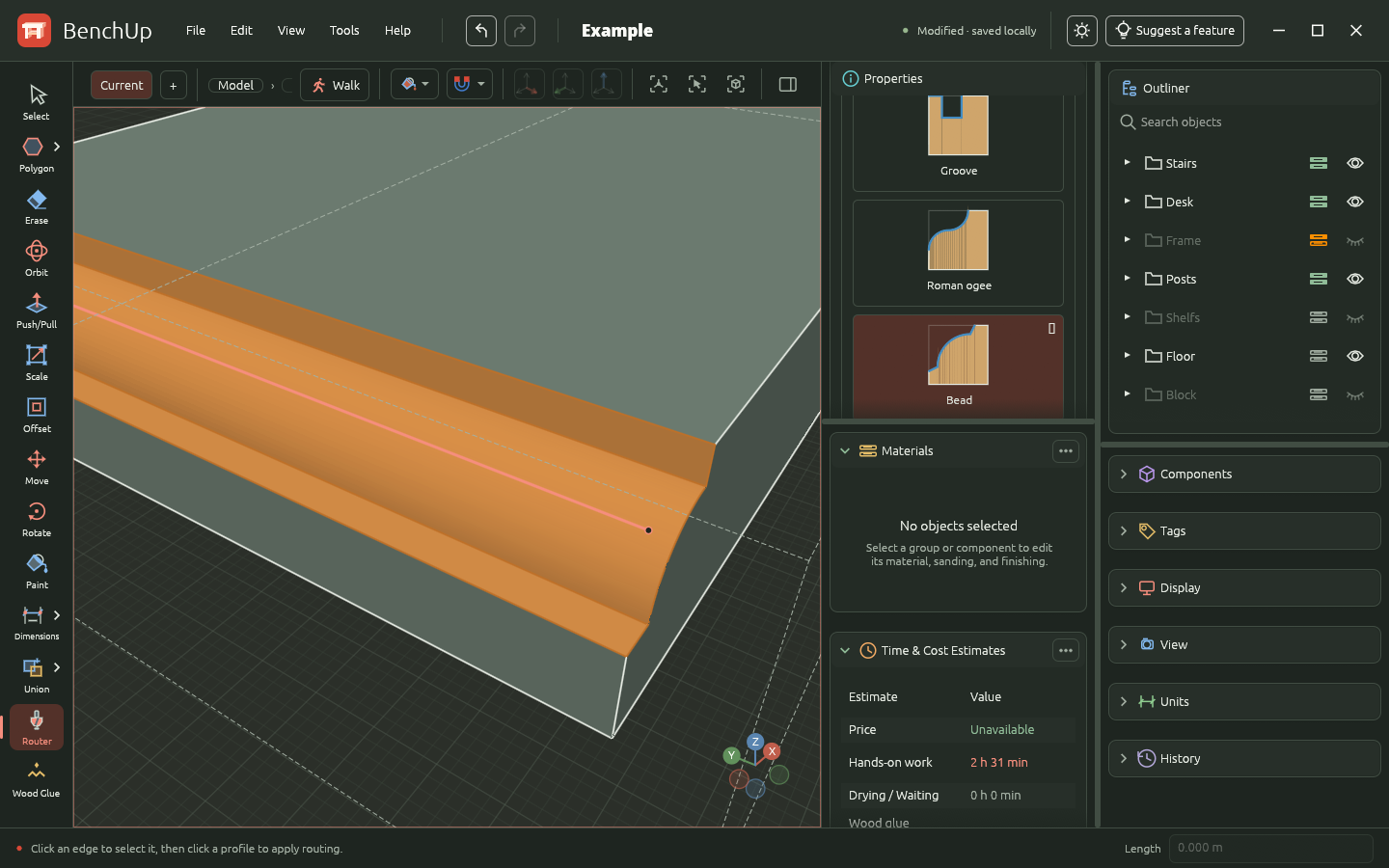
Select an edge, then choose a profile in Properties to apply it immediately. Shape it with a chamfer, bevel, roundover, cove, rabbet, groove, Roman ogee, or bead, and adjust the profile dimensions to suit the part.
Change the profile later or choose None to remove routing while preserving the original stock. Lines drawn on a solid face can also become routing paths. Saved routes add their length and work time to your project estimates.
Assign stock materials and wood types, configure sanding and finishing products, then use the Tools menu to export printable PDFs. Every report includes the BenchUp header, project name, and generation date.
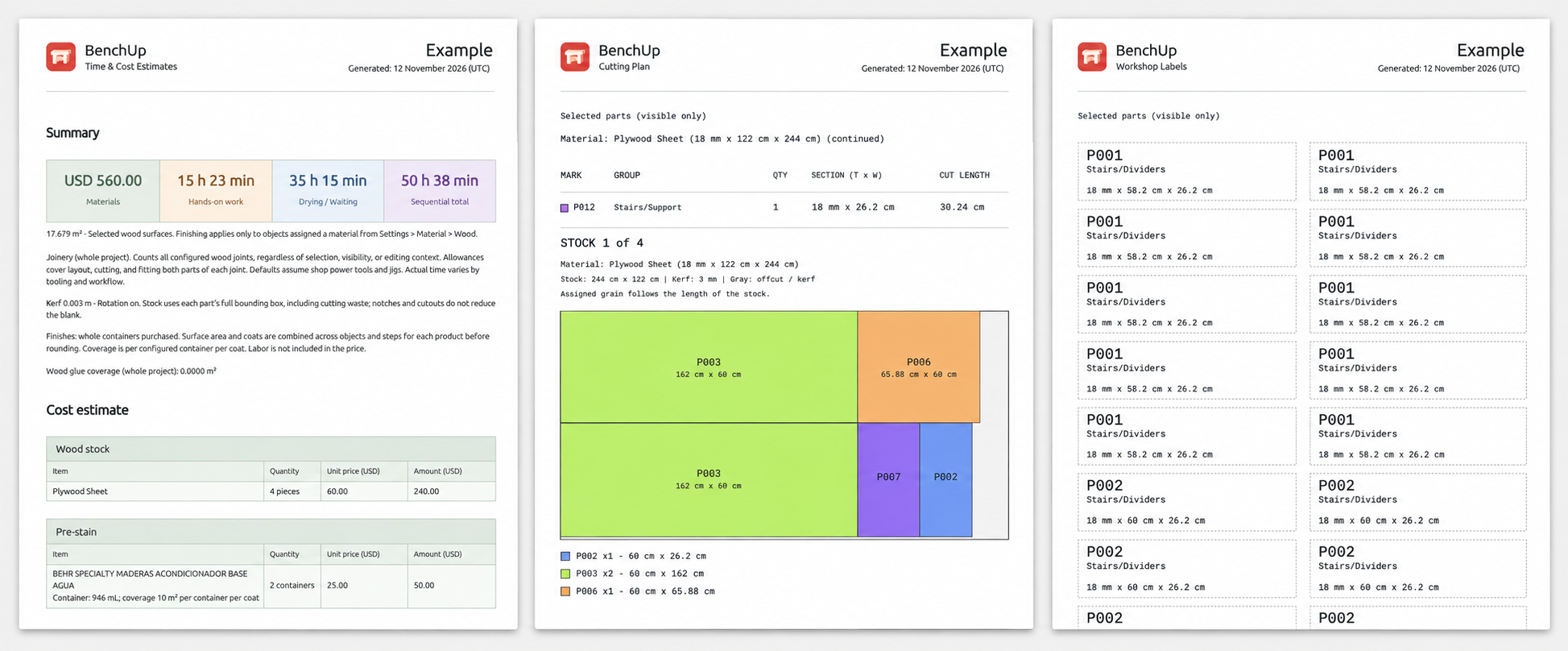
Plan purchases and workshop time with material costs, hands-on work, drying and waiting time, and the sequential total. Detailed tables cover stock and finishing supplies, workshop tasks, and joinery allowances. Labor is not included in the material price.
Group matching parts by material and size, with quantities and finished cutting dimensions. Color-coded stock layouts show marked parts, saw kerf, and offcuts, taking grain direction and rotation settings into account. Parts that do not fit are flagged separately.
Print one label per piece with its part mark, group or component name, and dimensions. Cut along the dotted borders and attach labels to keep similar boards identifiable during assembly. Part marks match the cutting plan.
Cutting plans and labels can cover selected parts or all visible parts in the project. Assign stock materials first, and verify dimensions before cutting.
Start with the browser editor or download the desktop app. Read the user guide for modeling instructions and supported workflows.
The editor opens with a clean slate.
Here’s a good place to start.
Click one corner, then the opposite corner to create your first face.
Choose Push/Pull, click the face, move your mouse, and click to finish.
Choose Orbit and drag to look around. Scroll to zoom; press F to fit your model.
A desktop browser with hardware acceleration and WebGPU or WebGL2 support. Use a mouse and keyboard for modeling. You can also run BenchUp as a native Windows, macOS, or Linux app.
Your model is autosaved in this browser on this device. Use File → Save to download a .bup project you can keep or open again. Legacy .bup projects are also supported. Clearing browser data can remove autosaved work, so download projects you want to keep. There’s no cloud storage or account to set up.
Use File → Import/Export to import SketchUp (.skp) geometry or export Wavefront OBJ (.obj). Imports run locally. SketchUp textures, scenes, and some model features aren’t supported; OBJ export includes geometry without materials.
Yes. BenchUp is open source under the MIT license and written in Rust. Explore the code, read the full guide, or contribute on GitHub.